The Critical Role of Precision in Lidar Housing Machining
At the heart of every reliable lidar system lies a component often overlooked yet fundamentally critical: its housing. This is not merely a protective shell; it is a precision-engineered foundation that dictates the system’s accuracy, longevity, and overall performance.
Lidar housing machining bridges advanced manufacturing with strict photonics and data acquisition requirements. For autonomous vehicles, even a micron-level deviation on sensor mounts can distort road perception. For aerial surveying, thermal instability of the housing will distort key topographic data. Machining precision is never an option but a must, turning raw materials into a stable and reliable carrier supporting the entire lidar system.
What is Lidar Housing Machining? Core Components & Process
Lidar housing machining is a professional subtractive manufacturing process, used to produce structural enclosures and internal parts for holding and aligning lidar sensitive optics and electronics.
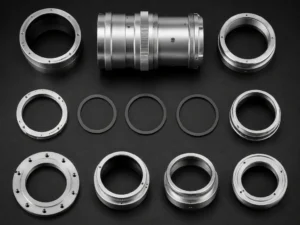
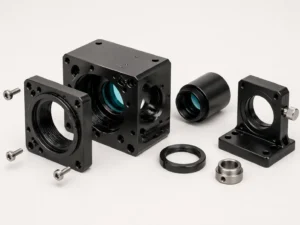
The integrated housing consists of multiple machined parts with separate functions:
- Main Enclosure: Provides environmental sealing and structural rigidity against dust, moisture and impact.
- Optical Mounting Bench: Ultra-precision machined brackets to fix lasers, receivers and mirrors in constant alignment.
- Aperture Window Frame: Precisely processed opening for optical glass or polymer windows, enabling unobstructed laser transmission.
- Thermal Management Structure: Integrated heat sink fins and cooling channels to dissipate internal heat.
CNC cutting tools carve complex geometries from solid material blanks, ensuring all dimensions and angles comply with strict lidar specifications.
Core Components of Machined Lidar Housing
- Main Enclosure: Defines overall outline and delivers IP-grade environmental protection.
- Optical Bench & Mounting Features: Sub-micron tolerance datum surfaces and threaded holes for optical alignment.
- Aperture Window Frame: Precision interface for sealed window installation without stress distortion.
- Thermal Management Structures: Integrated heat sinks and cooling mounting points for temperature control.
- Interface & Connector Ports: Reserved openings for electrical, data and assembly installation.
Why Precision Matters: How Tolerances Affect Lidar Performance
Lidar performance is extremely sensitive to housing machining precision. Tiny misalignment of laser transmission paths, even micrometer-level deviation, will cause beam drift and pointing errors, which magnify over distance and lead to wrong object positioning. In autonomous driving, it may cause critical errors in judging pedestrian distance.
Precision machining also guarantees structural stability. Vibration or thermal expansion will not deform the housing or shift internal alignment, avoiding data drift. The flatness of mounting surfaces and perpendicularity of holes directly affect signal-to-noise ratio and angular resolution. Mechanical errors cannot be fully corrected by software, and will permanently reduce the reliability of point cloud data.
Key Materials for Lidar Housings
Aluminum Alloys 6061-T6 / 7075
Industry mainstream choice, with excellent strength-to-weight ratio, good corrosion resistance and machinability. High thermal conductivity helps heat dissipation, while thermal expansion requires targeted structural optimization. 7075 is suitable for aerospace and high-end industrial scenarios.
Composites & Engineering Polymers
CFRP carbon fiber composite features ultra-light weight, high rigidity and nearly zero thermal expansion, maintaining perfect dimensional stability. PEEK offers chemical resistance and high-temperature adaptability for harsh working conditions.
Advanced Special Alloys
Titanium alloy delivers ultra-high strength and corrosion resistance for extreme environments. Invar features extremely low thermal expansion, ideal for high-precision optical benches. Magnesium alloy is ultra-lightweight with strict flammability control required.
Machining Process: From CNC Milling to 5-Axis Fabrication
Lidar housing adopts standardized CNC machining workflow:
3-axis milling completes basic outline, inner cavity and conventional mounting features. For complex curved surfaces and undercut structures, 5-axis CNC machining is essential, realizing one-time clamping integral processing, eliminating cumulative assembly errors.
High-speed machining(HSM) optimizes surface finish and tightens tolerances while reducing material residual stress. Micro tools are applied for tiny threaded holes and fine vent structures. The whole process follows roughing → semi-finishing → finishing to ensure dimensional accuracy and structural integrity.
Surface Finishing & Coatings: Durability and Optical Performance
Aluminum housings mostly adopt hard anodizing for hardness, wear resistance, corrosion resistance and insulation; black anodizing absorbs stray light and suppresses optical interference. Chromate conversion coating enhances corrosion resistance for marine and outdoor scenarios.
Powder coating provides thick protection against chemicals, UV and abrasion. The inner wall adopts matte black light-absorbing treatment to eliminate internal reflection. Optical windows are coated with multi-layer AR anti-reflective film to maximize laser signal transmission efficiency.
Quality Control and Metrology
Strict quality inspection runs through the whole process: First Article Inspection(FAI) verifies design specifications; CMM coordinate measuring machine and laser scanning compare actual parts with CAD models to check flatness, perpendicularity and position accuracy at micron level.
Functional tests include helium leak detection for IP sealing grade, thermal cycle testing simulating extreme temperature changes, and spectral detection for coating reflectivity. Full-process verification ensures the housing matches high-reliability lidar application standards.
Industry Applications
Automotive & Autonomous Vehicles
With the strictest working conditions of -40℃~85℃ thermal shock, vibration, salt spray and high-pressure washing. Compact integrated design, ultra-tight window tolerance, long-life coating guarantee driving safety and perception accuracy.
Robotics & Industrial Automation
Focus on impact resistance, dustproof and EMI shielding, modular design for robot integration. Precision alignment ensures stable navigation and obstacle avoidance perception.
Topographic Surveying & Mapping
Aerial and ground survey lidar uses lightweight high-rigidity materials, with large-size high-precision optical windows and excellent thermal stability, adapting to altitude temperature changes and condensation prevention.
Other Scenarios
Smart city traffic monitoring, defense ruggedized equipment, portable archaeological scanning equipment all adopt customized machining solutions according to working environment.
Future Trends & Innovation
Multi-sensor integrated housing becomes mainstream, integrating lidar, camera and radar in one-piece structure, relying on 5-axis even 7-axis CNC for integral processing.
Advanced composite materials such as CFRP are widely applied for lightweight and low thermal drift. Metal 3D printing combines CNC finishing to realize special-shaped heat dissipation structures and simplify assembly.
Intelligent manufacturing upgrades with on-machine real-time detection and digital twin full life cycle traceability, supporting large-scale mass production while maintaining high precision and cost optimization.
Summary of Key Points
Lidar housing machining is a precision-driven core discipline connecting design and actual application. It is not only a protective shell, but a core opto-mechanical carrier determining lidar accuracy and stability.
Precision tolerance decides optical performance; material selection matches application scenarios; multi-axis CNC process achieves complex structure; surface coating balances protection and optical effect; full-set metrology ensures delivery quality; customized design adapts automotive, robot, surveying and other industries. Continuous innovation in materials, technology and intelligent manufacturing will further empower the large-scale popularization of high-performance lidar systems.